


The video marketing KPIs that matter most are view-through rate, engagement rate, click-through rate, conversion rate, and cost per lead. These five metrics connect video performance directly to business outcomes, not just vanity numbers. If you’re spending money on video production and only tracking view counts, you’re flying blind with an expensive camera rig and no monitor.
Related: video production services in Dallas, each as a fixed-fee package.
According to Wyzowl’s 2026 State of Video Marketing report, 91% of businesses now use video as a marketing tool, and 82% of marketers say it delivers a strong return on investment. But here’s the disconnect: most marketers still measure video success using views (67%) and surface-level engagement like likes and shares (63%), while only 32% track bottom-line sales impact. That gap between investment and measurement is where real money gets wasted.
In this guide, you’ll learn:
- Which video marketing KPIs drive actual revenue, and which ones just feel good
- How to set benchmarks for each metric based on video type and platform
- The measurement framework we use at Image Media Lab to prove video ROI for our clients
- Common tracking mistakes that make video look like a cost center instead of a growth engine
What Are Video Marketing KPIs and Why Do They Matter?
Video marketing KPIs, key performance indicators, are the specific, measurable metrics you use to determine whether your video content is achieving its intended business goal. That last part is critical. A KPI without a business goal behind it is just a number on a dashboard.
Think of it like a film shoot. You wouldn’t evaluate a production’s success based solely on how many hours of footage you captured. You’d measure it by whether the final cut tells the story, hits the emotional beats, and delivers the message the client needs. Video marketing metrics work the same way, the raw numbers only matter when they connect to what you’re trying to accomplish.
The reason KPIs matter more now than ever is scale. With 82% of all internet traffic projected to be video content and the average person watching 17 hours of online video per week, the volume of content competing for your audience’s attention is staggering. You can’t afford to produce video and hope for the best. You need a feedback loop, shoot, publish, measure, refine, and KPIs are the engine of that loop.
Which Video Metrics Actually Drive Business Growth?
Not all video metrics are created equal. The ones worth tracking depend entirely on where a viewer sits in your marketing funnel. A brand awareness video at the top of the funnel has different success criteria than a product demo designed to close a sale. Here’s how we break it down.
Top-of-Funnel KPIs: Awareness and Reach
View count gets a bad reputation as a vanity metric, and in isolation, that’s fair. But view count still matters as a directional indicator of reach, especially when paired with unique viewers and impression data. If nobody sees your video, nothing else matters. The key is not obsessing over view count alone.
Impressions and reach tell you how many people had the opportunity to see your video versus how many actually pressed play. A high impression count with a low play rate signals a thumbnail or headline problem, your content is being served but not earning the click. That’s a fixable creative issue, and catching it early saves campaigns.
Mid-Funnel KPIs: Engagement and Interest
View-through rate (VTR) measures what percentage of viewers watched your video to completion, or to a specific milestone like 25%, 50%, or 75%. This is one of the most telling video marketing KPIs because it reveals whether your content actually holds attention. According to Wistia’s analysis of over 100 million videos, how-to videos under one minute see average view-through rates around 82%, while longer content between 1 and 30 minutes still holds viewers past the 50% mark if the content delivers real value.
Engagement rate captures likes, comments, shares, and saves, the actions that signal a viewer found your content worth interacting with beyond passive watching. Shares are especially valuable because they extend organic reach without additional ad spend. When someone shares your brand’s video, they’re essentially vouching for it to their own network.
Average watch time tells you, in real minutes and seconds, how long people actually stayed. This is more granular than VTR and helps identify exactly where viewers drop off. If you see a cliff at the 15-second mark on a 90-second video, your hook isn’t working. If viewers bail right before the call-to-action, your pacing needs tightening. We review watch time curves on every project at Image Media Lab because the data directly informs how we edit the next cut.
Bottom-of-Funnel KPIs: Conversion and Revenue
Click-through rate (CTR) measures how many viewers clicked a link, CTA button, or card within or alongside the video. This is where video stops being a branding exercise and starts generating measurable leads. A strong CTR on a product demo or explainer video means your content is compelling enough to push viewers into the next stage of the buyer’s journey.
Conversion rate tracks how many of those clicks resulted in a completed action, a form fill, a purchase, a demo request, or a phone call. This is the KPI that connects video directly to revenue, and it’s the one that gets CFOs to approve next quarter’s video budget. If 85% of consumers say they’ve been convinced to buy a product after watching a video, and your own videos aren’t converting, the problem isn’t the medium, it’s the execution or the measurement.
Cost per lead (CPL) and cost per acquisition (CPA) put your video investment in dollars-and-cents context. If you spent $10,000 on a video campaign that generated 200 qualified leads, your CPL is $50. Compare that to your other channels, and you’ll know exactly where video sits in your marketing mix. This is the language that resonates in boardrooms.
How Do You Set Video KPI Benchmarks That Make Sense?
Benchmarks are only useful if they account for context. A 45% view-through rate on a 15-second social media ad is mediocre. That same 45% on a 5-minute brand documentary is excellent. Platform, video length, content type, and audience all shift what “good” looks like.
Here’s a general framework to start with. For short-form social videos (under 60 seconds), aim for VTR above 60% and engagement rates between 3-6%. For mid-length content like explainer videos and testimonials (1-3 minutes), a VTR of 40-60% is solid. For long-form content like webinars, case study films, or behind-the-scenes documentaries (5+ minutes), a 30-40% VTR indicates genuinely compelling content.
CTR benchmarks vary dramatically by platform. YouTube in-stream ads average around 0.65% CTR, while video embedded in email campaigns can hit 2-3% or higher because the audience is already warmed up. The point is this: never benchmark against a generic “industry average” without matching the format. A LinkedIn video and a TikTok clip live in completely different ecosystems and should be measured against their own baselines.
The best approach is to establish your own internal benchmarks. Track your first three to five videos in each format and platform, calculate your averages, and use those as your baseline. Then aim to beat your own numbers by 10-15% each quarter. This matters far more than chasing someone else’s stats.
What Video Marketing KPI Mistakes Cost You the Most?
The most expensive mistake isn’t tracking the wrong KPIs, it’s tracking the right ones incorrectly. Here are the pitfalls we see most often when clients come to us after working with other production teams or managing video in-house.
Treating all views as equal. A three-second autoplay “view” on a social feed is not the same as someone who intentionally clicked play and watched 80% of your video. Platforms define “view” differently, YouTube counts a view at 30 seconds, Facebook at 3 seconds, and YouTube Shorts recently changed their counting methodology in early 2025 to align views with when a Short starts to play or replay. If you’re comparing view counts across platforms without normalizing the definition, your data is misleading.
Ignoring audience retention curves. Aggregate metrics like total views or average watch time can hide critical problems. The retention curve, a graph showing exactly when viewers drop off, is where the real production insights live. A sharp drop at the 8-second mark means your hook failed. A gradual decline through the middle suggests pacing issues. A spike of drop-offs right before the CTA means you lost them at the finish line. Every production decision, scripting, editing pace, music, graphics, shows up in the retention data.
Measuring too early. Video content, especially organic and SEO-optimized video, compounds over time. A video that looks like it underperformed in week one might become a top performer over six months as it climbs in search rankings and gets shared. We recommend giving organic video a minimum 60-90 day window before making performance judgments, while paid campaigns can and should be evaluated in real time.
Not connecting video data to your CRM. Over half of video marketers now connect their video platform to their CRM or email marketing tool. If you’re not doing this, you can see that someone watched your video, but you can’t see that the same person requested a demo three days later. Attribution is everything. Without it, video lives in a measurement silo and looks like a cost center instead of a sales driver.
How Should You Build a Video KPI Dashboard?
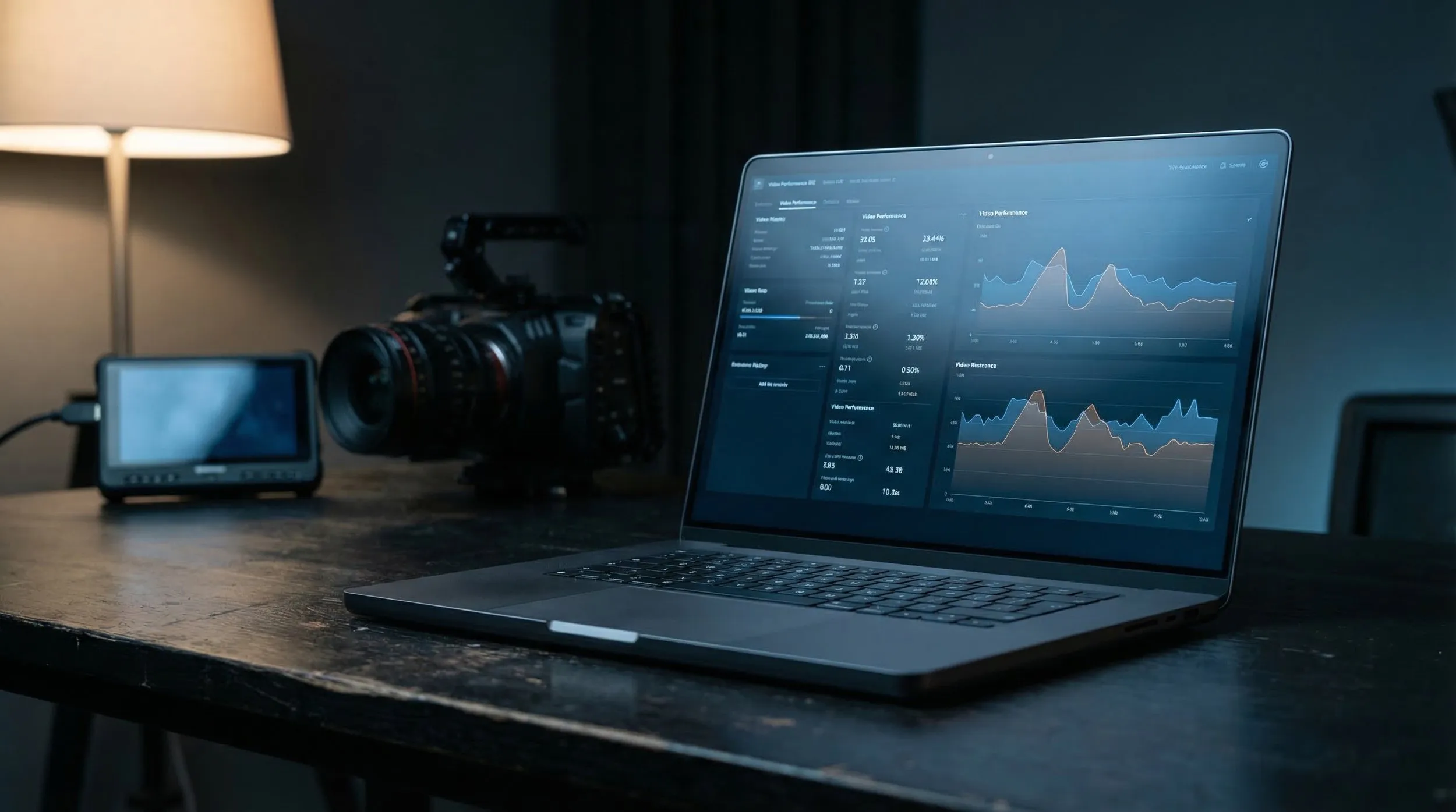
A video marketing KPI dashboard doesn’t need to be complicated, but it does need to be structured around your actual goals. Here’s the framework we recommend to our clients at Image Media Lab, it works whether you’re running one campaign or fifty.
Step 1: Define one primary goal per video. Before a single frame is shot, decide what the video’s job is. Is it building awareness? Driving demo requests? Educating existing customers? One video, one primary objective, one primary KPI. A brand anthem film is measured by reach and sentiment. A product walkthrough is measured by CTR and conversion. Trying to make a single video do everything dilutes both the creative and the measurement.
Step 2: Select two to three supporting KPIs. These are the metrics that add context to your primary KPI. If your primary goal is lead generation (measured by conversion rate), your supporting KPIs might be CTR (are people clicking through?) and average watch time (are they watching enough to be persuaded?). Three supporting metrics is the sweet spot, enough to understand the full picture without drowning in data.
Step 3: Set a reporting cadence. For paid campaigns, review daily or weekly. For organic content, review monthly with a quarterly deep dive. The quarterly review is where you look at trends across your entire video library, which formats outperform, which topics resonate, where drop-off patterns repeat, and use that intelligence to inform your next production cycle.
Step 4: Build a comparison layer. Every video should be compared to previous videos of the same type, same platform, and same objective. Comparing a TikTok testimonial to a YouTube product demo tells you nothing. Comparing your March product demo to your January product demo tells you whether you’re improving. This is how you turn data into a genuine feedback loop for your production team.
How Image Media Lab Approaches Video Marketing KPIs
At Image Media Lab, we don’t just produce videos and hand over a file. Every project we deliver comes with a measurement strategy that connects creative decisions to business metrics. When we plan a shoot, we build the KPI framework before we build the shot list, because how a video will be measured directly influences how it should be produced.
A video built for awareness needs a strong hook in the first three seconds and high production value that reflects the brand. A video built for conversion needs a clear, compelling CTA and a narrative structure that systematically addresses objections before the ask. A video built for engagement needs pacing, personality, and a reason for the viewer to comment or share. Same client, same brand, three different production approaches, all driven by the KPI behind the brief.
After delivery, we walk every client through their analytics and help them understand not just what happened, but why, and what to do differently next time. That continuous improvement loop is what separates a production company that makes videos from one that drives results.
Frequently Asked Questions
What video marketing KPIs should I track first?
Start with view-through rate and click-through rate. VTR tells you whether your content is engaging enough to hold attention, and CTR tells you whether it’s persuasive enough to drive action. These two metrics together give you a clear baseline of content quality and conversion potential before you add more granular tracking.
How do you calculate ROI on video marketing?
The simplest formula is: (Revenue attributed to video minus total video cost) divided by total video cost, multiplied by 100. For example, if a $15,000 video campaign generated $60,000 in trackable revenue, your ROI is 300%. The challenge is attribution, connecting a video view to a downstream sale, which requires CRM integration and proper UTM tracking on every video link.
What is a good view-through rate for a marketing video?
It depends on video length. For videos under 60 seconds, aim for 60% or higher. For 1-3 minute videos, 40-60% is strong. For content over 5 minutes, anything above 30% indicates genuinely compelling material. Always benchmark against your own past performance, not generic industry averages that don’t account for your specific format and audience.
What’s the difference between vanity metrics and real video KPIs?
A vanity metric is any number that looks impressive but doesn’t connect to a business outcome. A million views means nothing if nobody clicked, converted, or remembered your brand. Real video marketing KPIs tie directly to a goal: VTR measures content quality, CTR measures persuasion, conversion rate measures business impact, and CPL measures efficiency. The metric itself isn’t vanity or real, the context is.
How much should a business spend on video marketing to see results?
Professional video production can range from $2,000 to over $50,000 per finished minute depending on complexity, crew size, and post-production requirements. The more important question is cost per result. A $20,000 video that generates 400 leads at $50 each is a better investment than a $2,000 video that generates nothing. Start with a clear goal, produce one strong piece, measure it rigorously, and scale based on data, not guesswork.
Final Thoughts
Video marketing KPIs are the bridge between creative investment and business impact. Track the right metrics, connect them to real goals, and use the data to make every production better than the last. That’s how you turn video from an expense line into a growth engine.
If you’re producing video and want a measurement strategy that actually proves value, we’d love to talk. Reach out to Image Media Lab and let’s build something worth measuring.