
Healthcare & medical video · Dallas and nationwide
Healthcare Video Production in Dallas Medical Interviews, Patient Stories & Hospital Films
Image Media Lab produces healthcare and medical video from Deep Ellum, Dallas, for hospitals, practices, and medical device companies across Dallas-Fort Worth: physician interviews are filmed in a half day, fixed-fee packages start at $3,500, and films deliver in 7 to 10 business days. For thirteen years we have filmed the people who make medicine for The Journal of Clinical Investigation, 15 Nobel laureates among them.
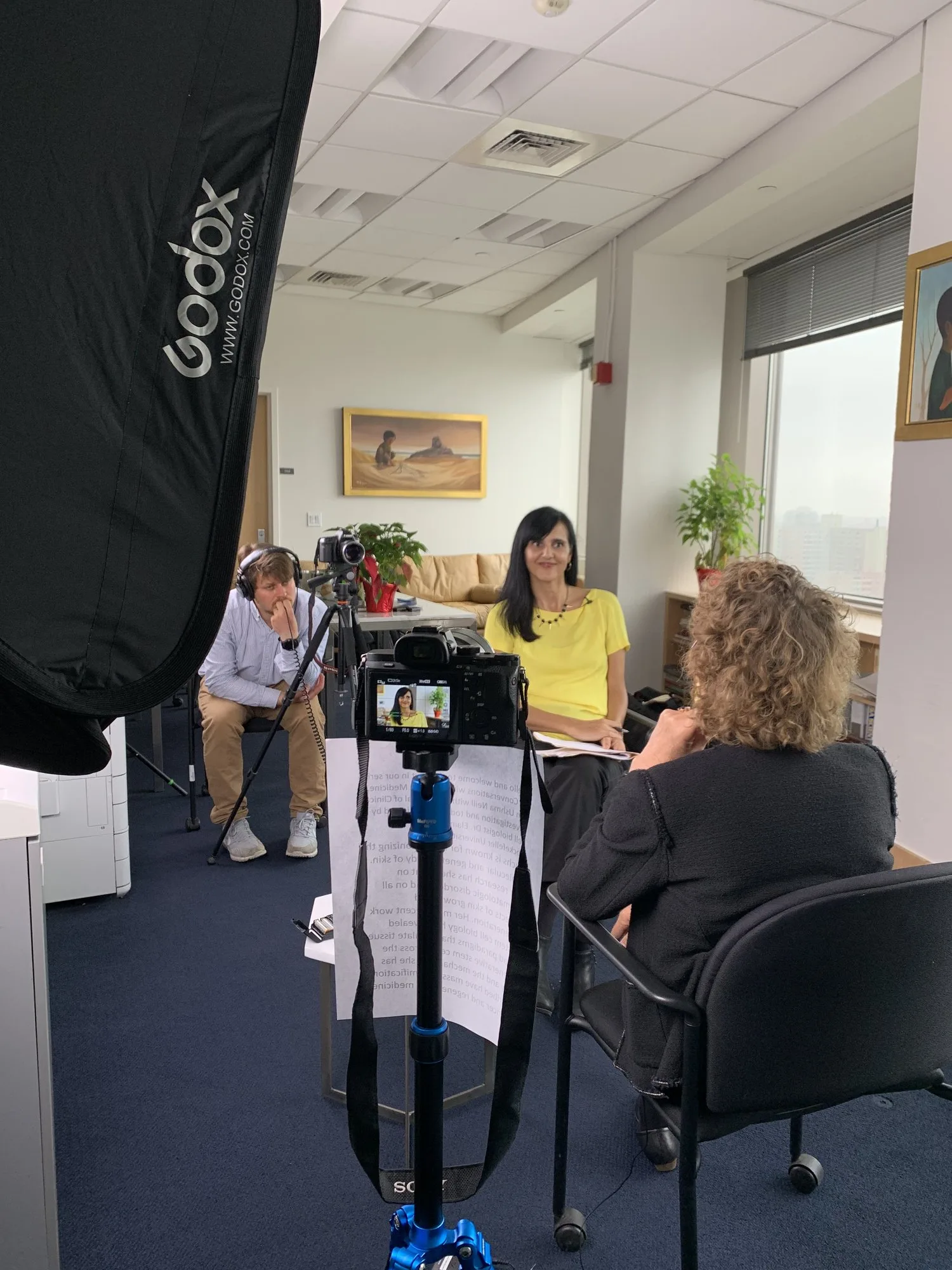
Every patient and staff member on camera signs a release. We work inside your privacy and compliance requirements, not around them.
Proof in motion
Science interview video sampleWatch an expert explain.
Columbia University virologist Vincent Racaniello, interviewed by Ushma Neill, on why viruses are everywhere: a hard subject, an expert who sounds like himself, and an edit built for a general audience.
Columbia University virologist Vincent Racaniello, interviewed by Ushma Neill, on his podcast This Week in Virology, three decades of polio research, how viruses shaped human biology, and why flying American Ebola patients home in 2014 was safe. A long-form interview produced by Image Media Lab.
Read the transcript
Ushma Neill: Hello, I'm Ushma Neill, here today with Vincent Racaniello, a polio virologist from Columbia University. Vincent has also taken on the mantle of Earth's virology professor. Beyond the classes he teaches at Columbia, he also runs a popular website called This Week in Virology, where he talks about interesting and newsworthy viruses and their place in today's world. Vincent, I'm so glad to have you here today.
Vincent Racaniello: Thanks, Ushma.
Ushma Neill: Do you think you could tell me a little bit about This Week in Virology?
Vincent Racaniello: We do a podcast every week. We get a bunch of virologists together and we just talk, and there's no script. We pick a couple of articles or what's going on in the news. The idea is to hear virologists talking about their field in a way that a lot of people can understand it.
Ushma Neill: Do you have a favorite virus?
Vincent Racaniello: It would have to be the virus I spent over 30 years working on, which is poliovirus, which is about to be eradicated, which is good for the world but sad for me in my laboratory, I guess.
Ushma Neill: Are there other viruses that interest you?
Vincent Racaniello: Well, I think the viruses that are basically in every cubic inch of the world are amazing: in the air, and all the animals and plants and insects in the world, and in our oceans. I find it amazing that they're all around us; you can't see them. Their mass, if you put all these viruses together, would weigh a thousand times more than all the elephants on the earth. If you line them up end to end, they would stretch 200 million light-years, way past the nearest galaxy.
So these are things you can't see with the naked eye, and as we go about our daily lives, we can't see these things, yet they have enormous impact on Earth. And probably if you took these viruses away, life would be very different. I would venture to say that we probably wouldn't exist if they weren't here.
Ushma Neill: There's probably any number of things that I haven't previously appreciated about viruses. Are there any particular factoids you could enlighten me with?
Vincent Racaniello: Well, viruses constitute about 8% of your and my and every other human on earth's nucleic acid, and that 8% got in many, many years ago because of a series of infections, and some of that is actually useful to us right now. Some of those bits of viral genes contribute to the formation of the placenta, for example. So if it weren't for viruses, we'd be laying eggs. And they would probably be blue, because we know that some viruses contribute to eggshell color in chickens. There's also one of that 8% that makes our stem cells able to differentiate into all the other cells in our body. So we have, during our evolution, acquired these infections, and in some cases we use them.
Ushma Neill: You know, you also mentioned something in passing about the sheer number of viruses that we excrete every day.
Vincent Racaniello: So each of us humans, not just humans, we have at least a dozen viruses, different kinds of viruses, in us at any given time. We get infected shortly after birth, or maybe within the first year of life, herpes viruses of all sorts, and those viruses stay with us; that's their modus operandi. Periodically they produce more offspring, and those infect other people, but for the most part we are okay with that.
But even beyond that, we have viruses in our bloodstream, tiny, tiny viruses with DNA nucleic acids that are in everyone, and we have no idea why they're there. And here is my favorite factoid about viruses in people. Each of us excretes in our urine every day about 100,000 viruses per milliliter. Per milliliter. So next time you go in a public bathroom and you flush the toilet, which of course generates an aerosol, just remember you're inhaling someone else's viruses.
Ushma Neill: What do you hope to accomplish with This Week in Virology?
Vincent Racaniello: So I'm hoping that This Week in Virology reaches enough people to teach them all about how cool viruses are, how they are an amazing part of the fabric of what we are, and that most of them are harmless. For example, if you took a liter of seawater, that liter, anywhere in the world, would have more virus particles than people on the planet, but if you drank it you'd be fine. Those viruses make a huge contribution to all of the food webs in the ocean, to photosynthesis, to cycling of carbon and nitrogen and phosphorus, but they're harmless to us.
I want people to realize how many good things arise from viruses, and that the ones that make us sick, the influenzas, the noroviruses, the chickenpox, those are a minority. I view those in a way as accidental infections that are probably not meant to be, because most of the virus infections out there are beneficial. So I want to teach this to people. I want them to understand viruses. I'm hoping along the way that they'll understand that vaccination is a good thing, and they won't be afraid when they hear the next outbreak.
Someone out there made me a virus particle. This happens to be poliovirus, but it's much bigger than it really is, of course. But it just shows you the simplicity, how these particles are built. So that's basically a virus. In this case it's a shell made of proteins, and inside the shell you can just see, sticking out here, is the nucleic acid, or the genetic information. And this person beaded for me the nucleic acid of poliovirus. There are four different bases making up the viral RNA: there's a U, an A, a C and a G, so she gave them each a different color bead and strung them together in the right order. And this bead, which I guess I could call a necklace, is 7,440 nucleotides long.
And when this virus infects a cell... So this virus, in order to make more of it, has to get inside of a cell, and this nucleic acid has to come out. And you see it's taking me a long time to do this. This is 10 meters long, and I'm getting stuck. Can you imagine? This happens within seconds, probably microseconds, in a cell. It's all worked out beautifully; the chemistry is just gorgeous. Should I take it all out? See how long it takes. So now we're getting tangled. Oh, she's put magnets in here to delineate regions.
But this is a process we call uncoating. This nucleic acid has to get out so that it can be made into proteins, so we can make more virus particles. We're almost at the end here, so in human time you see this just takes forever. And now this nucleic acid would be out in the cell. It would go and direct the synthesis of new particles, and this wonderful vehicle, this beautiful, what we call a capsid, this would just be degraded and fall apart. Its purpose is finished.
Ushma Neill: I'd love to hear what your opinion is on Ebola, which is really in the news right now in 2014 after sickening and killing hundreds and thousands of Africans, and even more specifically about the controversy of flying back Americans that were sickened with Ebola, and whether or not that was a good idea.
Vincent Racaniello: Sure. So I want to preface it by telling you a story about what got me interested in being a virologist. When I graduated from college, I wasn't sure what I wanted to do. So after college I went home and I got a job as a lab technician, and during that year I read a book called Fever by John Fuller. And Fever was the description of the first emerging virus infection. It was Lassa virus, which emerged in Nigeria out of nowhere and started killing healthcare workers, very much like Ebola does. And that book made me want to be a virologist. A lot of that story actually took place at Columbia University Medical Center, where I work.
So fast forward: now we know there are other dangerous viruses which have animal reservoirs. In places like Africa, they can inhabit bats or other animals in the forest, and where bushmeat is used as a source of food, people can get infected inadvertently with these viruses. So that's what happens with Ebola. You get some meat that has the virus in it, you eat it, and then you get infected. And unfortunately the virus is not well adapted to people. It doesn't play nice with them, so it causes a very, very nasty hemorrhagic disease, which is often fatal.
Now, the problem in the countries in Africa where this disease is spreading is that the healthcare facilities are not well developed. So here in the US we have something called infection control. If you're in the hospital and you have an infectious disease that is likely to spread to others, you can be very well isolated, and it won't infect anyone else. Unfortunately, if you have Ebola hemorrhagic fever in certain places in Africa, you go to the local hospital, which may consist of a room or two, and you're likely to spread the infection to the healthcare workers who are taking care of you. They'll then go home and spread it to their family. If you die, your family will prepare your body in the traditional method; they'll have to process it themselves, with their own hands, and they will get the infection as well. It's nothing at all like influenza, where if I had flu, you would be getting it, of course. But Ebola doesn't do that.
So bringing a person back from Africa with Ebola hemorrhagic fever is absolutely fine. That person will be put into a high-containment care facility. I believe they're going to Atlanta. And healthcare workers will exercise exquisite infection control when they deal with the patient, and it will not spread to anyone else. So it's actually a good idea, because those individuals will not be able to spread the infection to anyone else. Of course, if we could bring all the infected people back, it could stop the outbreak, but we can't do that. So it's a great idea, and people should not be afraid of it.
Ushma Neill: Can you leave us with one final parting thought about how interesting virology is?
Vincent Racaniello: Virology is so interesting that I think viruses were probably on earth before cellular life as we know it. I think there were little bits of these nucleic acids floating in the primordial soups of the developing earth, and from those emerged cellular life. So I like to say that all of us came from viruses. If you look at it that way, they are really cool.
Ushma Neill: Thanks for joining us here on the Wild Types, and thank you again to my colleague Vincent Racaniello. I think we'll all remember a lot of these little things about viruses, and I have a feeling you'll never look at your pee the same way again.
01 / The standard
Medical video production experienceHard to explain.
That is the job.
Since 2012 we have produced “Conversations with Giants in Medicine” for The Journal of Clinical Investigation: long-form interviews with the physicians and scientists who shaped modern medicine, filmed in their offices, labs, and lecture halls. The discipline that series demands, a precise question, a specialist at ease, and an edit that a general audience can follow, is the same discipline a hospital brand film, a patient story, or a device launch needs.
02 / What we produce
Healthcare video formatsSix formats.
One clinical standard.
Every format below is produced by the same senior team, with releases, privacy, and the clinical schedule planned before the first frame.
- 01
The expert, understood
Physician and researcher interviews
Service-line explainers, research announcements, and leadership messages, directed so a specialist sounds like themselves and a patient, a donor, or a board member understands them the first time.
- 02
Consent first, then the camera
Patient and caregiver stories
Testimonial films built around one person's experience of care, from the first call through recovery, with releases, privacy, and dignity handled before the crew arrives.
- 03
The mission, in three minutes
Hospital and health-system brand films
Facility openings, service-line launches, foundation campaigns, and the film that explains what your system is for, shot across departments with the people who run them.
- 04
Clinical, not salesy
Medical device and health-tech product videos
Product demonstrations, clinician testimonials, and founder stories for device companies and health-tech startups, from the bench to the exam room.
- 05
Protocols people finish
Medical education and clinical training
Onboarding, protocol, device, and continuing-education modules with your own clinicians presenting, captioned and delivered ready for your learning platform.
- 06
Nurses, residents, donors
Recruiting and foundation films
Recruiting films for nursing and residency programs, and foundation and gala films that show donors exactly what their gift does.
03 / Packages
Healthcare video packages and pricingFour fixed fees
that fit clinical work.
Most healthcare projects map onto one of these packages. The price is the full fee; multi-site system films and ongoing programs are quoted as one number after discovery.
-
The Executive Spotlight
$3,500One physician, researcher, or executive on camera: a service-line message, a recruiting note, or a leader introduction.
-
The Success Story
$3,500A patient, caregiver, or referring physician telling a real story, filmed with consent handled properly.
-
The Corporate Narrative
$6,000The hospital, practice, or health-tech brand film: several voices, the facility, and the mission in under three minutes.
-
The Onboarding Series
$6,500Clinical onboarding, protocol, and device training modules from one production day, delivered LMS-ready.
04 / On set in clinical settings
Filming in hospitals and clinicsConsent, privacy,
and a small footprint.
A hospital is not a studio. The crew, the schedule, and the paperwork are planned around care, and the practices below are standard on every healthcare shoot.
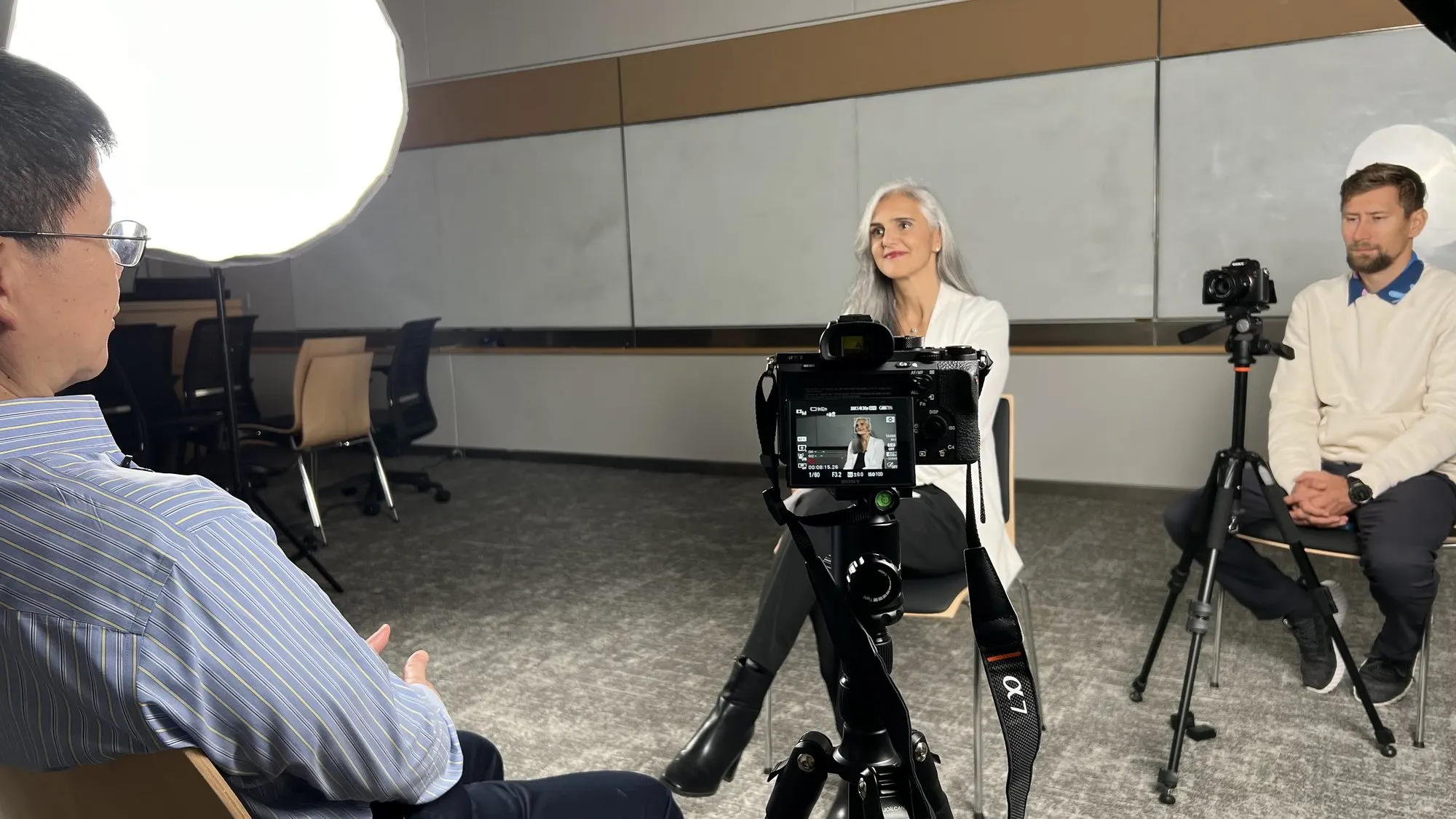
We do not need protected health information to make a good film, so we do not collect it. What we need is a cleared space, people who have chosen to be on camera, and a schedule that respects the unit. Your communications lead approves the questions, your compliance lead approves the plan, and the crew arrives already briefed.
Standard on every healthcare shoot
- Signed releases for every patient, family member, and staff member on camera
- No protected health information captured: screens, charts, whiteboards, and wristbands are cleared or masked
- Closed sets in patient areas, coordinated with communications, nursing, and compliance
- A small footprint crew that fits an exam room and works around care
- Your infection-control policy followed on set, gear wiped down, crew masked where required
- Your NDA and vendor onboarding signed before day one; footage handled on encrypted drives and delivered on private links
05 / The record
Medical interview series for The Journal of Clinical Investigation80 giants of medicine,
on camera.
The longest-running work in the studio is a medical interview series, and it is the reason healthcare teams call us first.
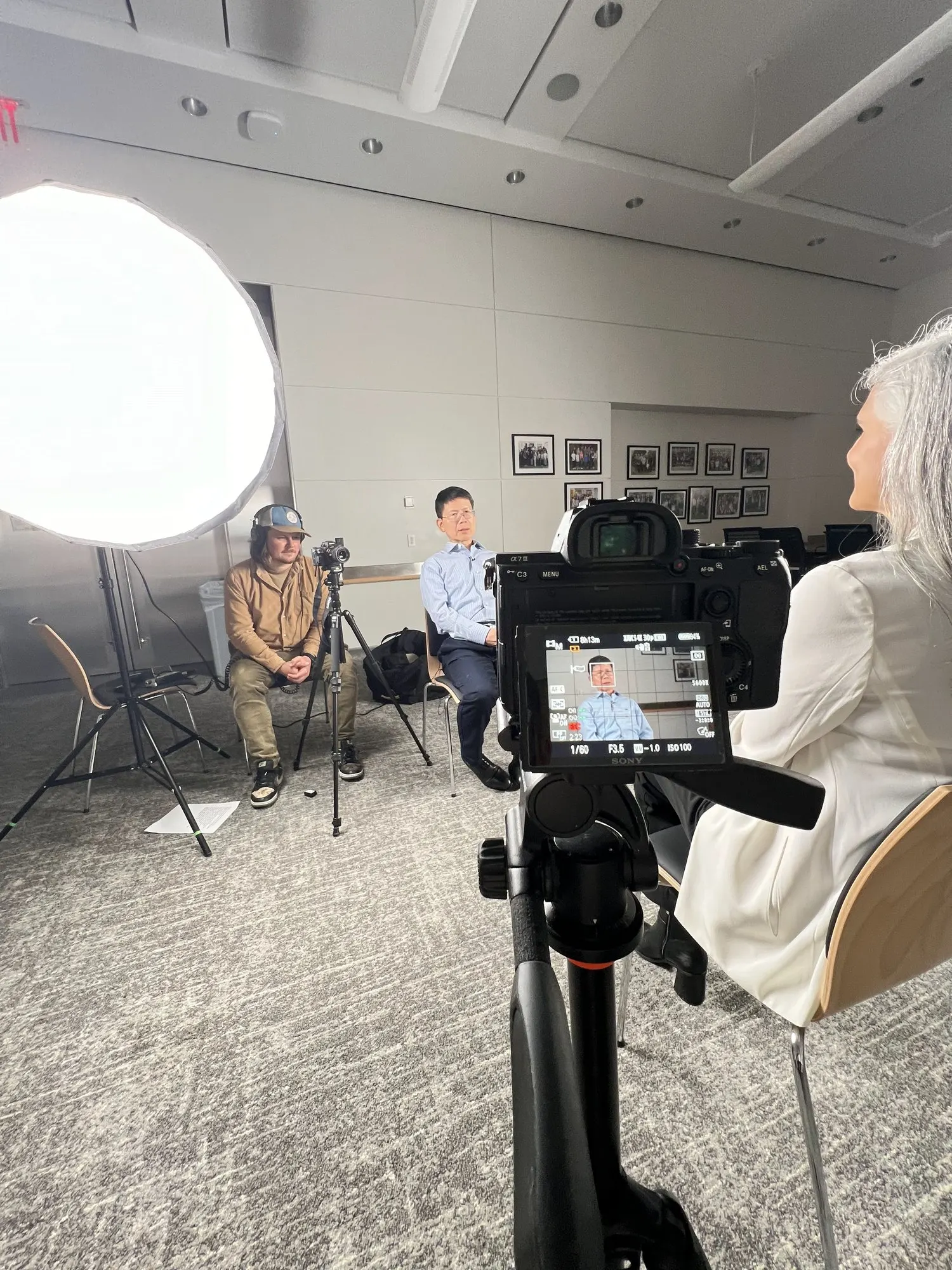
“Conversations with Giants in Medicine” is The Journal of Clinical Investigation’s interview series with the people who shaped modern medicine. Image Media Lab has produced it since 2012: 80 leading physicians and scientists on camera, including 15 Nobel laureates and 27 Lasker winners, each interview filmed on location and edited so the science stays intact and the person comes through.
The series taught us how to work around a clinician’s calendar, how to light an office in twenty minutes, and how to ask the question that gets the clear answer. Those habits are now the default on every healthcare shoot we take.
The series host, on camera
Ushma Neill hosted Conversations with Giants in Medicine. Press play to hear her on working with the studio.
Ushma Neill, PhD, host of Conversations with Giants in Medicine for The Journal of Clinical Investigation, on working with Image Media Lab to film the series' interviews with Nobel laureates and other leaders of science, and on the editing that keeps each conversation tight.
Read the transcript
Hi, I'm Ushma Neill of The Journal of Clinical Investigation, and just as myself. And in these capacities, of working for the JCI and as an independent scientist who wants to communicate about it, I've worked with the Image Media Lab over the last two and a half to three years to produce what I think is scintillating content about the history of science, from interviewing Nobel laureates and Knight Bachelors of the Order of the British Empire.
I've had a fascinating time kind of telling the story of science. I wouldn't be able to do it without Image Media Lab. They make me look good when I flub my lines. They help me edit things out that I didn't actually mean to say, or when some of the people drone on a little bit too long.
They've been essential partners in my ability to tell the story of science, and I couldn't do it without them. Thank you, Image Media Lab.
06 / How it works
How a healthcare video project worksFour steps,
built around care.
One senior team from discovery to delivery, with your communications and compliance leads involved at the two points where their sign-off matters.
- 01
Discovery
The audience, the message, and the constraints, with your communications and compliance leads in the room. We recommend a package or a custom scope and confirm the fixed fee.
- 02
Pre-production
Interview questions drafted for approval, releases and location clearances arranged, a walkthrough of the units or labs we will film in, and a shot list that respects the clinical schedule.
- 03
Production day
One to three interviews and cleared B-roll in a half day. Cinema cameras, broadcast audio, and a director who keeps a nervous specialist calm and clear.
- 04
Post and delivery
The hero film, vertical cuts, captions, and professional photos, with a review round for communications and legal built in. Delivery in seven to ten business days by package.
Can you film in patient-care areas?
Yes, with your team's clearance. We film in units, clinics, ORs, and labs under a closed-set plan agreed with nursing, communications, and compliance: only cleared spaces, only people who have signed releases, and no protected health information in frame. The crew follows your infection-control and badge policies on set.
How do you handle patient consent and privacy?
Every patient, family member, and staff member on camera signs a release before we record, and we use your release language when you have it. We do not need protected health information to make a video, so screens, charts, and paperwork are cleared or masked, and the footage is stored on encrypted drives and delivered on private links.
Will you sign a business associate agreement?
We sign your NDA and complete your vendor onboarding before the first shoot. Because we do not receive or store protected health information to produce a video, most health systems engage us as a media vendor rather than a business associate; your compliance team makes that determination and we follow it.
Can you make complex research understandable on camera?
It is the work we are best known for. For The Journal of Clinical Investigation we have filmed 80 giants of medicine, including 15 Nobel laureates and 27 Lasker winners, in conversations that make frontier science clear to a general audience. The method carries over: the right question, a specialist who sounds like themselves, and an edit that respects the viewer's time.
Do you produce clinical training and medical education video?
Yes. The Onboarding Series turns one production day with your clinicians into a library of protocol, device, and onboarding modules, captioned and delivered ready for your learning platform. Continuing-education content follows the same process with your accreditation requirements built into the script review.
What does healthcare video production cost in Dallas?
Fixed-fee packages start at $3,500 for a single-subject interview film and run to $6,500 for a full production day of training modules. Multi-location system films, campaigns, and ongoing content programs are quoted as one number after discovery, never by the hour.
Start a project
Tell us about the story.
The audience, the people who will be on camera, and where the film will run. We reply within one business day with a recommendation, the fixed fee, and the first available production date.
Brief received
Thanks. You’ll hear from us in writing within one business day.
Your brief is with our Dallas team. If it is urgent, call (469) 370-9832 and we will pick up. If a call helps after the first reply, pick a time.