
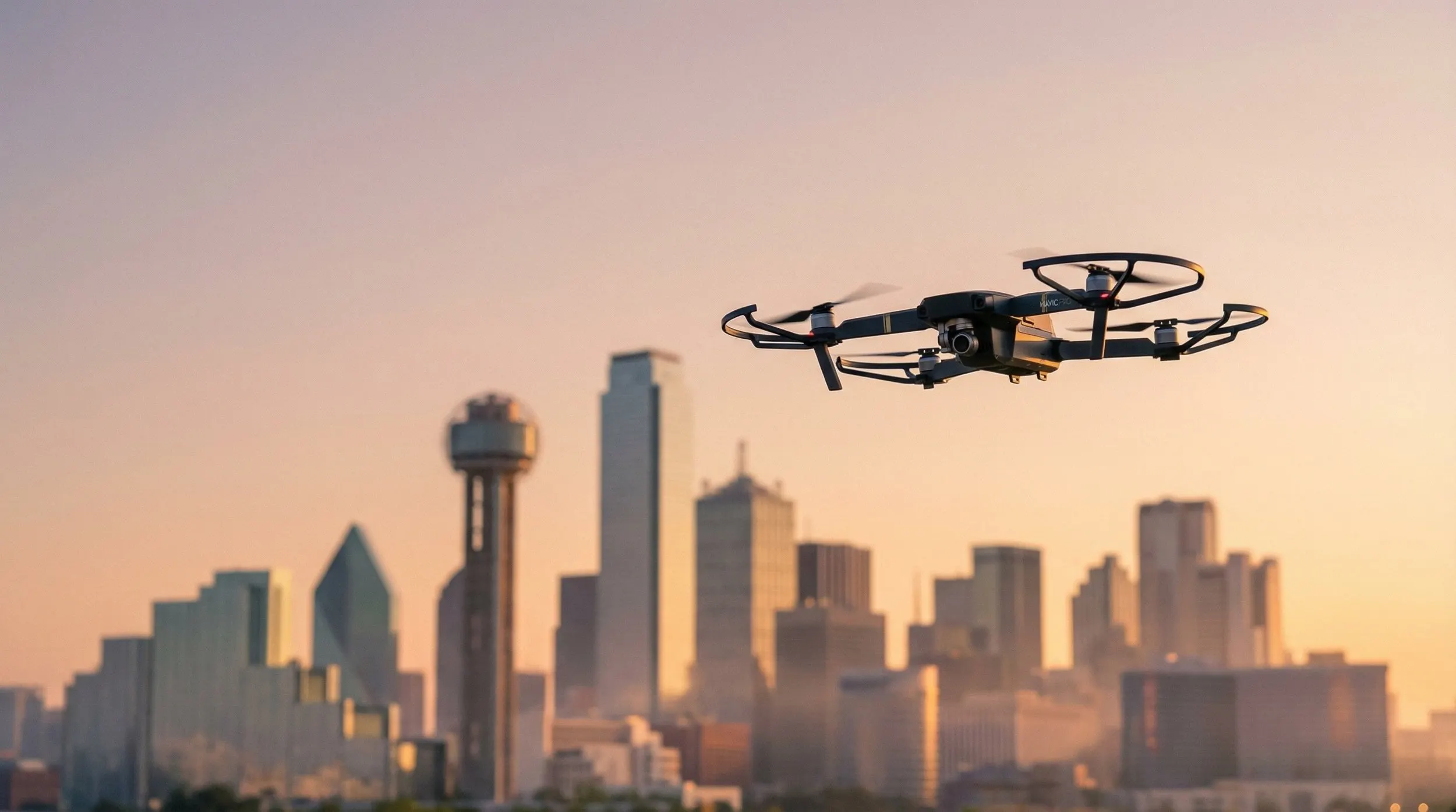
Three questions come up on almost every drone project in Dallas-Fort Worth: can you fly this at night, can you fly over the crowd, and are we too close to the airport. The honest answer to all three is usually “yes, and no waiver is needed, but here is what the pilot has to do first.” This guide explains which flights need a Part 107 waiver, which need an airspace authorization instead, and what a client should ask a drone vendor before the shoot or the inspection is on the calendar.
Related service: FAA Part 107 drone services across Texas, including inspections from $900 and construction progress programs.
First, the baseline: what Part 107 already allows
Part 107 is the FAA rule for commercial drone operations. Under it, a certified remote pilot can fly a registered aircraft under 55 pounds, below 400 feet above ground level, within visual line of sight, in uncontrolled airspace, away from people who are not part of the operation, during the day. Every commercial flight, from a roof inspection in Plano to a brand film in Deep Ellum, starts from that baseline. A waiver is the FAA’s written permission to deviate from a specific Part 107 rule after you show how you will manage the risk. An airspace authorization is a different document: permission to fly in controlled airspace, which is not a waiver at all.
Three baseline items your vendor should be able to show on request:
- A Part 107 certificate with recurrent training completed within the last 24 calendar months.
- Aircraft registration for each drone, with the number displayed on the airframe.
- Remote ID. Since March 16, 2024, drones that require registration must broadcast Remote ID, either built into the aircraft or through an attached broadcast module, unless they fly inside an FAA-recognized identification area.
Flying at night: no waiver since 2021, two requirements instead
Night operations used to be the most common Part 107 waiver. That ended in April 2021, when the FAA folded night flying into the standard rule. A commercial pilot can now fly at night without a waiver if two conditions are met:
- Anti-collision lighting on the aircraft that is visible for at least three statute miles and flashes at a rate sufficient to avoid a collision.
- Training. The pilot has passed the updated knowledge test or completed the current recurrent training, both of which cover night operations.
What a good vendor adds on top of the rule is the site work: a daylight scout of the obstacles that disappear after dark, especially cranes, guy wires, and unlit poles, a launch point with a clear view of the flight area, and a visual observer for anything more complex than a static shot. Texas has no state rule that adds to the federal night requirements.
Flying over people: it depends on the aircraft, not the pilot
This is the question with the most confusion, because the answer changed in 2021 and depends on the specific drone. The FAA’s operations-over-people rule sorts aircraft into four categories:
- Category 1: aircraft weighing 0.55 pounds or less with no exposed rotating parts that could cut skin. These can fly over people without a waiver, and over open-air assemblies only with Remote ID.
- Category 2 and 3: heavier aircraft with a manufacturer’s declaration of compliance accepted by the FAA, showing the drone meets injury-severity limits on impact. Category 3 aircraft cannot sustain flight over open-air assemblies, and can only fly over people who are inside a restricted-access site or who have been notified that a drone may fly over them.
- Category 4: aircraft holding an airworthiness certificate, maintained and operated under it.
Most of the cinema and mapping drones that produce good work are heavier than Category 1 and do not carry a Category 2 or 3 declaration. So for the typical event, the practical rule is simpler than the regulation: the aircraft does not fly directly over the crowd. The pilot plans the flight lines to the side, above the stage edge, or over the water, and the sweeping shot over the audience that a client imagines is usually a shot from beside it. Where a project genuinely needs sustained flight over people with an aircraft that does not qualify, the route is a waiver of the over-people rule, which takes months to obtain and is rarely granted for a single event. Plan the flight instead.
A related rule covers flight over moving vehicles, which matters for freeway and highway shots in DFW. The same category logic applies, with an added requirement that the vehicles be inside a closed or restricted-access area or the flight remain brief, so most road footage is planned from the shoulder or the overpass rather than directly above traffic.
Flying near DFW airports: an authorization, not a waiver
Dallas-Fort Worth is one of the busiest patches of airspace in the country, and a surprising amount of the metro sits inside or under controlled airspace. Class B airspace surrounds DFW International and Dallas Love Field. Class D airspace surrounds Addison, Dallas Executive, Alliance, Meacham, Arlington Municipal, Grand Prairie Municipal, McKinney National, and Denton Enterprise, among others. A job site in Las Colinas, a rooftop in Uptown, or a warehouse near Alliance is very likely inside one of them.
Flying there requires an FAA airspace authorization, and for most sites the pilot gets it through LAANC, the Low Altitude Authorization and Notification Capability. The FAA publishes grid maps around each airport with a maximum altitude for automatic approval in each square, from 400 feet down to zero. If the requested flight is at or below the grid ceiling, the authorization arrives in near real time. If the grid ceiling is zero, or the flight needs to be higher than the grid allows, the pilot files a manual request with the FAA that can take days to weeks. A vendor who quotes a flight inside a zero grid for tomorrow morning has not checked the map.
Two other things sit around DFW airspace that are not on the grid maps:
- Temporary flight restrictions. Stadium TFRs apply during major sporting events at venues seating 30,000 or more, including AT&T Stadium, Globe Life Field, and the Cotton Bowl: three nautical miles and 3,000 feet, from one hour before the event to one hour after. Presidential visits and some public events add their own. The pilot checks NOTAMs the day of the flight.
- Heliports and hospital helipads. Not controlled airspace in most cases, but a flight plan near a hospital in the Medical District accounts for helicopter traffic and keeps clear of approach paths.
Which waivers vendors actually hold
Since night flying and most operations over people moved into the standard rule, the remaining Part 107 waivers cover situations most commercial jobs never reach:
- Beyond visual line of sight. Needed for long linear inspections such as pipelines and transmission lines flown from a single launch point. This sits outside standard Part 107 privileges and needs a specific FAA approval, either a waiver or operation under the FAA’s dedicated beyond-line-of-sight rules where they apply. A roof, a job site, or an event does not need it.
- Above 400 feet. Rare in practice; inspecting a tall structure already allows flight within 400 feet of the structure itself.
- Sustained flight over people or moving vehicles with a non-qualifying aircraft, discussed above.
- Multiple aircraft with one pilot. Drone light shows, not inspections.
A vendor holding a waiver is not automatically a better vendor for your project; most projects do not need one. What matters is that the pilot knows which rule applies to your site and has already handled it when the quote arrives.
Texas adds its own layer
Federal rules govern the airspace; Texas governs what can be photographed and where a drone can take off. The Texas Government Code’s drone chapter, Chapter 423, restricts capturing images of private property or people on it without consent, with exemptions that cover most commercial work done with the property owner’s permission. Separately, state law bars flying at or below 400 feet over critical infrastructure such as refineries, power plants, chemical plants, water treatment facilities, telecommunications switching offices, ports, and dams without the operator’s consent, and over large sports venues on event days. Several DFW cities also restrict launching and landing in city parks, which affects where a crew can set up for a skyline shot.
For a client the practical consequence is simple: the vendor should ask who owns the property, who owns the neighboring property the shot will cross, and whether anything on the critical-infrastructure list sits within the flight area. Our 2026 commercial drone laws guide covers Chapter 423 and the federal rules in more detail.
The vendor checklist
Before the flight is booked, a drone vendor in Dallas-Fort Worth should be able to answer every line below in writing:
- Part 107 certificate number and the date of the last recurrent training.
- Aircraft registration and how Remote ID is met on the aircraft you will fly.
- The airspace class at the site and whether LAANC or a manual authorization applies, with the request already filed.
- For night flights, the anti-collision lighting on the aircraft and the plan for obstacles.
- For flights near people, the aircraft’s over-people category or the flight plan that keeps the aircraft off the crowd.
- A certificate of liability insurance naming your company, if you require one.
- A pre-flight risk assessment: weather minimums, launch point, visual observer, emergency procedures.
- Property permission for the site and any neighboring property the flight will cross, and a check of Chapter 423’s critical-infrastructure list.
What this means for three common DFW projects
- A roof inspection in Plano. Daylight, no crowd, and a site that is probably under a LAANC grid for Addison or McKinney. The pilot checks the grid, files the request, and flies the next morning. No waiver.
- A night event in downtown Dallas. Anti-collision lighting and current training cover the night portion. The aircraft flies beside the crowd, not over it. The site sits inside Love Field’s Class B, so the authorization is filed with the grid ceiling in mind, days ahead.
- A monthly progress flight at a job site near Alliance. Class D airspace, LAANC on file for the whole program, flights scheduled around crane operations, and no waiver of any kind.
Rules change, and the FAA revises its guidance more often than most clients would expect, so treat this as the 2026 picture and ask the vendor what has changed since. If the project is in Texas and you want a pilot who has already done the checking, tell us about the site and the authorization situation comes back with the quote.